
Volume 14 Issue 1 *Corresponding author compans.ipp@gmail.com Published 17 May 2026 Citation SILVA, R. C. The Urban Dystopia in Copacabana. Coleção Estudos Cariocas, v. 14, n. 1, 2026.
DOI: 10.71256/19847203.14.1.220.2026 The article was originally submitted in PORTUGUESE. Translations into other languages were reviewed and validated by the authors and the editorial team. Nevertheless, for the most accurate representation of the subject matter, readers are encouraged to consult the article in its original language.


| The urban dystopia in Copacabana A distopia urbana em Copacabana La distopía urbana en Copacabana Rosemary Compans da Silva¹ 1Câmara Municipal do Rio de Janeiro, Praça Floriano s/n°- Centro, ORCID 0009-0008-5987-8674, compans.ipp@gmail.com
AbstractThe present study aims to explore hypotheses for the population decline in Copacabana, as evidenced by the 2022 Census. Both the neighborhood and Administrative Region V (RA V) were those that lost the most residents in the entire South Zone between the last two censuses. The study does not focus on indicators such as household income, household density, or age structure, supposedly common to the other neighborhoods in the region. Instead, it concentrates on real estate dynamics through the analysis of data provided by the ITBI, SECOVI, and short-term rental platforms, with the aim of investigating relevant changes in the process of real estate appreciation. Keywords: real estate appreciation; short-term rental; gentrification
ResumoO presente trabalho tem como objetivo explorar hipóteses para o esvaziamento populacional de Copacabana, evidenciado pelo Censo 2022. Tanto o bairro quanto a Região Administrativa (V RA) foram os que mais perderam moradores, em toda zona sul, entre os dois últimos censos. O estudo não focaliza indicadores como renda familiar, densidade domiciliar ou estrutura etária, supostamente comuns aos demais bairros da região. Ao invés disso, concentra seu olhar na dinâmica imobiliária, através da análise de dados disponibilizados do ITBI, do SECOVI e de plataformas de aluguel de curta temporada, no intuito de averiguar alterações relevantes no processo de valorização imobiliária. Palavras-chave: valorização imobiliária; aluguel de temporada; gentrificação
ResumenEl presente trabajo tiene como objetivo explorar hipótesis para el vaciamiento poblacional de Copacabana, evidenciado por el Censo 2022. Tanto el barrio como la Región Administrativa (V RA) fueron los que más perdieron habitantes en toda la zona sur entre los dos últimos censos. El estudio no se centra en indicadores como renta familiar, densidad domiciliaria o estructura etaria, supuestamente comunes a los demás barrios de la región. En cambio, concentra su mirada en la dinámica inmobiliaria, a través del análisis de datos disponibilizados por el ITBI, el SECOVI y plataformas de alquiler de corta temporada, con el propósito de averiguar alteraciones relevantes en el proceso de valorización inmobiliaria. Palabras clave: valorización inmobiliaria; alquiler de temporada; gentrificación |
1 Introduction
Living in Copacabana once represented, for many, the realization of a dream: the attainment of social prestige and a joyful, modern lifestyle, even if residing in small apartments and without sufficient income to enjoy the chic or vibrant private spaces that gathered Rio's elite in the 1950s and 1960s. That is what anthropologist Gilberto Velho (1973) showed us in his classic book "A Utopia Urbana"[1]. The study analyzed the perceptions of residents of a building on Bolívar Street[2], which guided their locational choices and the neighborhood's appeal to them.
However, the continued demographic decline of the neighborhood over four decades leads us to believe that the social phenomenon described by the author is very likely dissipating. In the last decade alone, Copacabana was the neighborhood that lost the most population in the entire South Zone: 17,473 people, as well as the one with the largest drop in the number of occupied permanent private households: minus 1,932 in the same period. What is happening to Rio de Janeiro's most famous neighborhood, the "Little Princess of the Sea"?
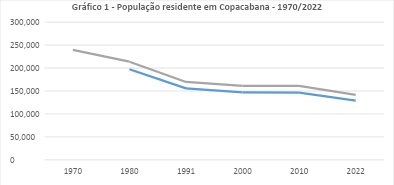
Figure 1: Resident population in Copacabana - 1970/2022
Source: IBGE; Demographic Censuses; IPP/PCRJ – 1998 Statistical Yearbook and DATA.RIO.
Some hypotheses can be formulated regarding this supposed "flight" of families from the neighborhood. However, none of them will be related to the devaluation of properties, because, as we shall see below, the average value of real estate transactions has been increasing, both in terms of buying and selling and leasing. The inauguration of three subway stations, the installation of UPPs in all the neighborhood's communities, the discovery of pre-salt oil, as well as the holding of major sporting events, were some of the factors driving the extraordinary property appreciation that occurred in the neighborhood over the last twenty years.
The hypothesis of increased life expectancy combined with declining fertility is not discardable, since residents over 60 years old represent no less than 33% of the population of Administrative Region V, while only 20% in the entire Municipality. This is a global phenomenon, but one that tends to produce more pronounced effects in localities where the proportion of elderly people is above average, as is the case of Copacabana. However, the increase of a specific age group does not, in principle, relate to the drastic vacancy of residential properties in a predominantly middle-class neighborhood.
Even more intriguing is the fact that the opposite occurred in the neighborhood's favelas, where there was exponential growth in both residents (+53%) and households (+107%)[3].
The hypothesis we will explore here, as the objective of this study, is that the loss of resident population and the record vacancy of residential properties in Copacabana was due, to a large extent, to the growing choice of owners for short-term rentals, instead of traditional rentals with a minimum duration of 30 months. To this end, we will present below the data that support this hypothesis, such as the property appreciation observed in the last decade, the rise in rental prices, and the spectacular number of properties registered on short-term rental platforms, compared to other neighborhoods in the City.
It should be clarified, however, that further research will be needed to support conclusive analyses. First, to determine whether the observed phenomenon occurs homogeneously across the territory or only in certain census tracts. It would also be essential to understand the predominant typology of occasional-use households – a category defined by the IBGE as properties used sporadically, without habitual residents, such as vacation homes. This profile, as it is often associated with leisure areas (especially during vacations, holidays, or events), directly dialogues with the characteristics of a neighborhood like Copacabana. Finally, it should investigate the predominant family income range in the migratory process and, obviously, the reasons that led to the decision to change neighborhoods, cities, or countries.
2 Unequal property appreciation
According to data from the ITBI Registry (Property Transfer Tax) tabulated by the Pereira Passos Institute, in the period between 2010 and 2022, the value of residential properties in Copacabana alternated between rising and falling, followed by a slight recovery after the easing of the COVID-19 pandemic. The holding of the World Cup in 2014 and the Olympic Games in 2016 was decisive for an extraordinary increase in prices observed there.
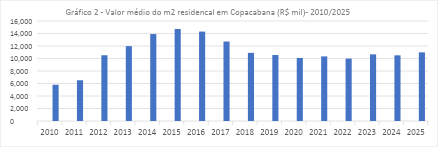
Figure 2: Average value per square meter of residential properties in Copacabana (thousands R$) - 2010/2025
Source: DATA.RIO – IPP/PCRJ
However, when we observe ITBI data by street address[4] – which already excludes those belonging to informal settlements – it becomes evident that fluctuations were constant, but appreciation was uneven depending on location, since square meter values in some cases differ significantly from the neighborhood average. The table below clearly shows the existence of 3 groups of addresses in Copacabana: the "noble" addresses, the "most valued" ones, and the "least valued" ones. The first group stands out for its stability, maintaining a very high value per square meter – always above the neighborhood average – even during the crisis period that began in mid-2016 and extended until 2022[5].
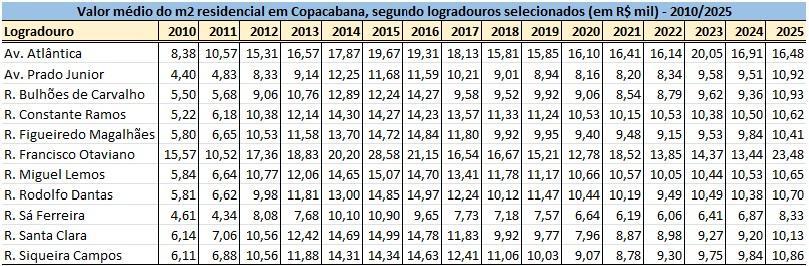
Figure 3: Average value per square meter of residential properties in Copacabana, by selected addresses (in thousands R$) – 2010/2025
Source: DATA.RIO – IPP/PCRJ
The second group remains very close to the neighborhood's average square meter value, and the average area of transactions is often similar to that of noble addresses, indicating good-quality properties. The third group consists of the least valued addresses, which are divided with respect to property size. In the cases of Prado Júnior Avenue and Siqueira Campos Street, annual average areas between 33 and 60 m² predominate. For others, such as Sá Ferreira Street, the average transaction area resembles that of the second group, but the average value is much lower.
It is worth noting at this point the apparent shift in what the market values, since in 2025, all selected addresses are equivalent, with the exception of Atlântica Avenue, and Francisco Otaviano and Sá Ferreira Streets, regardless of property area. This data suggests that small properties – studio apartments, one-bedroom units, or so-called "compact apartments" – have appreciated more than the better-quality properties that predominate on Miguel Lemos, Constante Ramos, or Bulhões de Carvalho Streets.
Although the average area of residential properties transacted in Copacabana remained stable over the analyzed period – around 80 m² –, after the post-pandemic market recovery shown in Figure 4, a slight decline in the annual average square footage in the selected addresses is noticeable, with the exception of Atlântica Avenue.
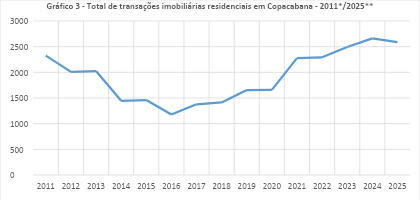
Figure 4: Total residential real estate transactions in Copacabana – 2011[6]/2025[7]
Source: DATA.RIO – IPP/PCRJ
If the observed real estate dynamics are indeed being driven by a revaluation of small or compact apartments, does this mean it is the cause of Copacabana's population emptying? There is no immediate causal relationship, as it depends on the use being made of the transacted property. Appreciation alone only points to a possible gentrification, in which higher-income families are replacing previous ones.
It becomes necessary, then, to analyze whether the use of transacted properties is intended for permanent or occasional residential use, or even merely as a store of value, keeping them vacant. Additionally, one must consider the behavior of rental prices, both long-term and short-term. That is what we will see next.
3 Households destined for short-term rental
In 2022, according to the IBGE, there were 2,920,214 housing units in the municipality of Rio de Janeiro[8], of which the overwhelming majority (97.87%) were permanent private dwellings, that is, intended for family residential use, unlike improvised dwellings (0.08%) and collective dwellings (0.05%), such as nursing homes, boarding houses, prisons, convents, etc. Of the 2,916,307 permanent private dwellings identified in the latest Census, 479,336 were unoccupied (16.43%), with 388,344 completely vacant and 90,992 for occasional use, whether used by the owner or by third parties through assignment or short-term rental.
In the Copacabana neighborhood, the proportion of unoccupied dwellings was much higher. Of the total 84,630 permanent private dwellings recorded in 2022, no fewer than 20,499 were vacant, representing approximately 24%. Unfortunately, it was not possible for us to disaggregate the data in order to determine the exact number intended for occasional use. However, if we estimate based on the same percentages obtained for the Municipality, these would amount to only 3,890 dwellings, which strongly contradicts the fact that 11 thousand properties are currently registered in the neighborhood on a single short-term rental platform.
Copacabana currently contributes (Inside Airbnb, 2025) 31% of the lodging units registered by Airbnb in the city[9]. Of the 13,009 accommodations available in the neighborhood, 85% are entire apartments or houses. In other words, in 2025, dwellings for occasional use intended for short-term rental already represent more than 13% of the permanent private dwellings existing in the neighborhood, considering that there are many other short-term rental websites.
Could this have been a trend observed during the intercensal period, with 1,932 more unoccupied dwellings in 2022 than in 2010, which has accelerated frenetically over the last three years?
Most likely. If we observe the list of “top hosts” provided by the aforementioned platform, we note that the first 48 concentrate 1,477 accommodations, the overwhelming majority of which are entire properties. The accumulation of residential properties among them ranges from 156 to 16 properties. These are investors, both companies and individuals, who acquire residential properties, renovate and furnish them, and place them in the lucrative ultra-short-term rental market. The predominant rental period ranges from 1 to 4 days.
Only a small portion of these properties may have originated from real estate developments, since these were scarce during the analyzed period. Indeed, between 1996 and 2022, only 165 residential units received occupancy permits in Copacabana[10]. It was only from 2021 onward, with urban incentives granted under the Reviver Centro Program, that a new construction impulse emerged in the neighborhood, with the licensing of eight residential developments totaling 995 apartments[11]. However, it is still not possible to assess how many of these already are or will be intended for short-term rental.
What we know so far is the advertising surrounding these new developments regarding the investment opportunity of “high profitability.” In fact, according to SECOVI data, Copacabana was the second neighborhood in the South Zone with the highest appreciation in residential rentals over the last twelve months, corresponding to 20.1%, second only to Laranjeiras, which in the same period presented a variation of +30.2%[12]. It should be noted, however, that the value per square meter estimated by the agency for residential rentals in the neighborhood, R$ 65.35 (in June 2025), suggests that it refers only to medium- and long-term contracts, since it is incompatible with the prices charged for daily lodging.
To understand the discrepancy between short- and long-term rental values, a quick visit to a popular real estate transaction platform is enough. There, one can find apartments of around 30 m², with prices ranging from R$ 190 to 250 per day[13], depending on location, which would allow for a monthly total of around R$ 6 thousand if rented continuously. Short-term rental prices are also increased according to seasonality, special dates, or events such as New Year’s Eve or concerts by Madonna and Lady Gaga, among others.
The expectation of greater profitability compared to traditional rentals may indeed be leading to the choice of short-term rental, but more in-depth research will be needed to measure the phenomenon. In addition to the vacancy of permanent private dwellings, the search for maximum profitability from residential properties consequently leads to gentrification, both through the increase in rents and condominium fees, in order to meet requirements such as modernization, cleanliness, and building security, as shown in the report by the newspaper O Globo[14] on the changes implemented in the famous Edifício Master beginning in 2021.
Located at 125 Domingos Ferreira Street, in the valued Posto 4 area, the building contains 276 studio apartments, and the daily lives of its residents were portrayed in the award-winning documentary of the same name[15] by Eduardo Coutinho, released in 2002. The aforementioned article shows that one-third of the units are already intended for short-term rental, and of the 38 lower-middle-class and low-income residents interviewed in the film, retirees, street vendors, sex workers, artists in decline or at the beginning of their careers, among others, only four remain in the building. In addition to the hiring of a landscape architect for the renovation and modernization of the entrance hall, a security company now provides services to the condominium through 14 employees.
According to some websites consulted, the price of 35 m² apartments reaches values ranging from R$ 450,000 to R$ 680,000, depending on their state of conservation and whether or not they are furnished, “ready to move in” in the language of real estate agents. This corresponds to a price per square meter ranging from R$ 13,000 to 19,000, much higher than the neighborhood average, or even than the selected streets shown in Graph 2 and Table 1 in the previous section. We found no references for long- or short-term rental values for this address.
Could what is happening in Edifício Master be the trend that explains the population decline in the Copacabana neighborhood? Although it certainly makes sense, it is not possible to generalize from such a tiny sample. We need more elements to prove it, more research.
4 Conclusion
The demographic emptying of Copacabana is not a new phenomenon, and can be attributed to the combination of several factors, including low birth rates, aging, or migration. In this article, we sought to shed light on aspects of real estate dynamics that may be contributing even further to the population decrease that has been common to the entire South Zone in the last decade. Based on the analysis of ITBI data, we saw that previously less valued addresses, where small apartments predominate, have appreciated more than others. The growth of short-term rentals, already traditional in the neighborhood with a strong tourist vocation, proved to be the most plausible hypothesis, reinforced by rising rents, by media reports regarding the transformations of old buildings composed of "studio apartments", and by data from one of the main very short-term rental platforms.
References
IBGE. Base SIDRA; DATA.RIO. Rio de Janeiro: Instituto Pereira Passos (IPP/PCRJ), [s.d.].
INSIDE AIRBNB. Rio de Janeiro. Disponível em: Inside Airbnb. Acesso em: 28 out. 2025.
O GLOBO. Edifício Master: duas décadas após filme, prédio em Copacabana está reformado, tem novo perfil de moradores e enfrenta desafios como os aluguéis de curta temporada. Rio de Janeiro, 5 jul. 2025.
PREFEITURA DA CIDADE DO RIO DE JANEIRO. Secretaria Municipal de Desenvolvimento Urbano (SMDU). Diagnóstico técnico do PMHIS/2025. Rio de Janeiro: Sistema de Licenciamento, 2025.
SABREN – SISTEMA DE ASSENTAMENTOS DE BAIXA RENDA. IPP/PCRJ. Dados preliminares do Censo Demográfico do IBGE 2022. Rio de Janeiro: Instituto Pereira Passos, 2022.
SECOVI RIO. Indicadores de locação. Disponível em: SECOVI Rio. Acesso em: 2 nov. 2025.
VELHO, Gilberto. A utopia urbana. Rio de Janeiro: Zahar, 1973.
ZAP IMÓVEIS. Disponível em: ZAP Imóveis. Acesso em: 2 nov. 2025.
About the Author
Rose Compans is an architect and urban planner, holding a PhD in Urban and Regional Planning. She has taught at the Faculties of Architecture and Urbanism at UFRJ and at the Instituto Metodista Bennett. She worked for over 30 years at the City Hall of Rio de Janeiro and currently works at the Municipal Chamber of Rio de Janeiro. She has dozens of works published in books and academic journals, including her award-winning doctoral thesis entitled "Urban Entrepreneurship: Between Discourse and Practice".
Author Contributions
Conceptualization, R.C.S.; investigation, R.C.S.; analysis, R.C.S.; writing—original draft preparation, R.C.S.; writing—review and editing, R.C.S.
Conflicts of Interest
The author declares no conflict of interest.
About Coleção Estudos Cariocas
Coleção Estudos Cariocas (ISSN 1984-7203) is a publication dedicated to studies and research on the Municipality of Rio de Janeiro, affiliated with the Pereira Passos Institute (IPP) of the Rio de Janeiro City Hall.
Its objective is to disseminate technical and scientific production on topics related to the city of Rio de Janeiro, as well as its metropolitan connections and its role in regional, national, and international contexts. The collection is open to all researchers (whether municipal employees or not) and covers a wide range of fields — provided they partially or fully address the spatial scope of the city of Rio de Janeiro.
Articles must also align with the Institute’s objectives, which are:
- to promote and coordinate public intervention in the city’s urban space;
- to provide and integrate the activities of the city’s geographic, cartographic, monographic, and statistical information systems;
- to support the establishment of basic guidelines for the city’s socioeconomic development.
Special emphasis will be given to the articulation of the articles with the city's economic development proposal. Thus, it is expected that the multidisciplinary articles submitted to the journal will address the urban development needs of Rio de Janeiro.
[1] Velho, Gilberto. A Utopia Urbana. Rio de Janeiro, Zahar, 1973.
[2] The Estrela Building, composed of 150 "studio" units, with 39 m².
[3] SABREN – Low-Income Settlement System. IPP/PCRJ. Based on preliminary data from the IBGE Demographic Census - 2022
[4] Only purchase and sale transactions, for residential use, apartment typology.
[5] The conclusion of the Olympic Games coincided with the impeachment process, resulting in a contraction of economic activity at the local level – especially in the construction and tourism sectors – and at the national level, given the scenario of political turbulence and uncertainty, the frustration of expectations regarding the exploration of the pre-salt layer, in addition to the impact of Operation Car Wash on the businesses of construction contractors with strong operations in the Municipality and the State.
[6] Due to incompleteness of the 2010 data, it was decided to exclude the year from the series.
[8] IBGE, SIDRA database; DATA.RIO, IPP/PCRJ.
[9] Data provided by the Inside Airbnb initiative, source: https://insideairbnb.com/rio-de-janeiro/, accessed on Oct. 28, 2025.
[10] Technical Diagnosis of PMHIS/2025. Source: Licensing System. SMDU/PCRJ.
[11] Urban Monitoring and Information Management – GMIU - SMDU/PCRJ
[12] htpps://www.secovirio.com.br/pesquisa-indicadores/indicadores-de-locacao/
[13] Htpps://www.zapimoveis.com.br. Visualizado em 02/11/2025. Accessed on 02/11/2025.
[14] "Edifício Master: two decades after the film, building in Copacabana is renovated, has a new profile of residents and faces challenges such as short-term rentals". O Globo, 05/07/2025.
[15] The documentary “Edifício Master” won the Kikito award, in Gramado, as the best in its category, in addition to five other major prizes at festivals and screenings, between 2002 and 2003.