
Volume 14 Issue 2 *Corresponding author prof.diego.ramos@soulasalle.com.br Submitted 16 Apr 2026 Accepted 24 Jun 2026 Published 30 Jun 2026 Citation RAMOS, D. M. S.; SORIANO, L. S. From Pain to Urban Catharsis: Pandemics, Carnival, and Contemporary Public Health Challenges in Rio de Janeiro. Coleção Estudos Cariocas, v. 14, n. 2, 2026.
DOI: 10.71256/19847203.14.2.224.2026 The article was originally submitted in PORTUGUESE. Translations into other languages were reviewed and validated by the authors and the editorial team. Nevertheless, for the most accurate representation of the subject matter, readers are encouraged to consult the article in its original language.


| From Pain to Urban Catharsis: Pandemics, Carnival, and Contemporary Public Health Challenges in Rio de Janeiro Da dor à catarse urbana: pandemias, carnaval e os desafios contemporâneos da saúde no Rio de Janeiro Del dolor a la catarsis urbana: pandemias, carnaval y los desafíos contemporáneos de la salud en Río de Janeiro Diego Marques dos Santos Ramos1 and Lucas Souza Soriano2 1Centro Universitário UNILASALLE-RJ, Rua Gastao Gonçalves, 79 – Santa Rosa, Niterói (RJ), ORCID: 0009-0003-1229-3170, prof.diego.ramos@soulasalle.com.br 2Centro Universitário UNILASALLE-RJ, Rua Gastao Gonçalves, 79 – Santa Rosa, Niterói (RJ), ORCID: 0009-0005-0038-9735, lucas.soriano@soulasalle.com.br
AbstractThis article analyzes Rio de Janeiro’s Carnival as an urban, cultural, and public health phenomenon, using the 1919 Carnival, held after the Spanish Flu crisis, as a historical-comparative framework to understand contemporary challenges in managing mega-events in post-COVID-19 Rio de Janeiro. The qualitative, documentary, and historical-comparative research combines narrative literature review, historical sources, institutional documents, and public data. The study argues that Carnival operates simultaneously as collective catharsis, reoccupation of public space, and symbolic recomposition of urban life, while also intensifying health vulnerabilities. Drawing on Henri Lefebvre, Michel Foucault, and Milton Santos, the article demonstrates that health risks are shaped by inequality, precarious mobility, housing conditions, and governance, proposing urban-health guidelines for mega-events. Keywords: Rio de Janeiro carnival; urban health; mega-events.
ResumoO artigo analisa o Carnaval carioca como fenômeno urbano, cultural e sanitário, tomando o Carnaval de 1919, após a Gripe Espanhola, como eixo histórico-comparativo para compreender os desafios contemporâneos da gestão de megaeventos no Rio de Janeiro pós-COVID-19. A pesquisa qualitativa, documental e histórico-comparativa articula revisão narrativa, fontes históricas, documentos institucionais e dados públicos. Sustenta-se que o Carnaval atua como catarse coletiva, reocupação do espaço público e recomposição simbólica da vida urbana, mas também intensifica vulnerabilidades sanitárias. Dialogando com Lefebvre, Foucault e Milton Santos, demonstra-se que o risco sanitário decorre das desigualdades, mobilidades precárias, moradia e governança, propondo diretrizes urbano-sanitárias para megaeventos. Palavras-chave: carnaval carioca; saúde urbana; megaeventos.
ResumenEl artículo analiza el Carnaval carioca como fenómeno urbano, cultural y sanitario, tomando el Carnaval de 1919, realizado después de la crisis de la Gripe Española, como eje histórico-comparativo para comprender los desafíos contemporáneos de la gestión de megaeventos en Río de Janeiro en el contexto posterior a la COVID-19. La investigación, de carácter cualitativo, documental e histórico-comparativo, articula revisión narrativa, fuentes históricas, documentos institucionales y datos públicos. Se sostiene que el Carnaval funciona simultáneamente como catarsis colectiva, reocupación del espacio público y recomposición simbólica de la vida urbana, pero también intensifica vulnerabilidades sanitarias. A partir de Lefebvre, Foucault y Milton Santos, se demuestra que el riesgo sanitario está mediado por desigualdades, movilidad precaria, vivienda y gobernanza, proponiendo directrices urbano-sanitarias para megaeventos. Palabras clave: carnaval de Río; salud urbana; megaeventos. |
1 Introduction
The city of Rio de Janeiro constitutes a privileged space for the analysis of the relationships among public health, culture, and urban form, insofar as it condenses, in its historical trajectory, complex processes of urbanization, socio-spatial inequality, and intense symbolic production. In this context, health crises are not merely biological events, but phenomena deeply rooted in territorial dynamics and in the forms of organization of urban life.
The experience of the Spanish Flu, upon reaching Rio de Janeiro in the early 20th century, starkly revealed the city’s structural fragilities, highlighting the direct relationship between urban density, precarious housing, and the spread of diseases. More than a century later, the COVID-19 pandemic re-actualizes these tensions in a context of advanced metropolization, intensified flows, and widening inequalities, placing once again at the center of the debate the need to understand health as a dimension intrinsically linked to the production of urban space.
It is against this backdrop that Rio’s Carnival — especially the emblematic 1919 Carnival — presents itself as a privileged object of investigation. Far from being understood solely as a festive manifestation, the event can be interpreted as a complex urban and cultural apparatus, in which processes of reoccupation of public space, collective elaboration of trauma, and symbolic reaffirmation of life are articulated. At the same time, in its contemporary dimension, Carnival constitutes a mega-event capable of intensifying flows, densities, and social interactions, thereby also becoming a potential vector for the amplification of health risks.
Thus, this article’s central theme is the relationship among pandemics, mega-events, and urban health in Rio de Janeiro, through a historical-comparative approach between different pandemic contexts and their associated cultural manifestations.
The general objective of the research is to analyze Rio’s Carnival — with emphasis on the year 1919 — as a socio-spatial response to the Spanish Flu health crisis, establishing a theoretical parallel with the recent experience of the COVID-19 pandemic, in order to understand the contemporary challenges of managing mass events in complex urban contexts.
The specific objectives include:
- Understanding the impacts of the Spanish Flu on the socio-spatial organization of Rio de Janeiro;
- Analyzing the 1919 Carnival as a manifestation of collective catharsis and reoccupation of urban space;
- Establishing relationships between the historical experience of 1919 and the COVID-19 pandemic;
- Discussing the role of mega-events in the intensification of urban flows and health risks;
- Proposing guidelines for the management of mass events in metropolitan contexts.
The research is guided by the following central question: in what ways can large-scale cultural events, such as Carnival, act simultaneously as devices of social resilience and as amplifiers of health vulnerabilities in unequal urban contexts?
The hypothesis is that the spread of diseases in pandemic contexts does not occur randomly, but is deeply conditioned by the city’s socio-spatial structure, with mega-events being critical moments of intensification of these dynamics, while also functioning as symbolic mechanisms of collective reconstruction.
From a theoretical standpoint, the work is based on the articulation among different fields of knowledge. The notion of the production of space, developed by Henri Lefebvre, allows understanding urban space as a result of social, political, and economic relations. The biopolitics perspective, proposed by Michel Foucault, contributes to the analysis of strategies for managing life and bodies in contexts of health crisis. In turn, Milton Santos’ socio-spatial reading makes it possible to understand territorial inequalities as central elements in the distribution of risks and vulnerabilities.
Methodologically, the research adopts a qualitative approach, of an exploratory and analytical nature, based on a literature review, historical analysis, and critical interpretation of secondary sources. The study is structured from a historical-comparative perspective, articulating different temporalities — 1918–1919 and 2020–2023 — in order to identify continuities, ruptures, and reconfigurations in the relationships among city, health, and culture.
Finally, the article aims to contribute to the field of urban studies and public health by highlighting the need for integrated approaches that simultaneously consider spatial, social, and cultural dimensions. It is expected that the results point to the importance of rethinking the management of mega-events in contemporary cities, incorporating strategies that articulate urban planning, socio-spatial justice, and health protection, especially in metropolitan contexts marked by inequality and high complexity.
2 The Pandemic City: The Spanish Flu and the Socio-Spatial Collapse of Rio de Janeiro
2.1 Global Circulation, Disease, and Territory: The Arrival of the Pandemic
The outbreak of the Spanish Flu, initially recorded in Europe in 1918, constituted one of the most devastating health crises in contemporary history. Its rapid spread was directly associated with the intensification of international flows in the context of World War I, turning the disease into a global phenomenon driven by human mobility.
The circulation of troops, goods, and ships became a privileged vector of propagation, highlighting the role of transportation networks in the diffusion of epidemics. In this sense, the disease can be understood as an expression of what Milton Santos calls the articulation among technique, territory, and circulation, in which flows, while connecting, also heighten vulnerabilities.
Upon reaching Rio de Janeiro, then the federal capital and the country’s main port, the pandemic found an urban environment highly conducive to its spread. The city, integrated into international circuits and characterized by intense population density, quickly became one of the main epicenters of the disease in Brazil.
2.2 Urban Form, Inequality, and Epidemiological Vulnerability
The spread of the Spanish Flu in Rio de Janeiro did not occur homogeneously, but followed the logic of the city’s socio-spatial organization. Areas with higher housing density, precarious infrastructure, and inadequate sanitary conditions showed a higher incidence of the disease, highlighting the direct relationship between urban form and epidemiological vulnerability.
Overcrowded tenements, lack of basic sanitation, and insufficient ventilation were determining factors for the rapid transmission of the virus. The city, in this context, acted as a true amplifier of the disease, insofar as its own material conditions favored the circulation of contagion.
This reading dialogues with the notion of the production of space proposed by Henri Lefebvre, according to which urban space is not neutral, but socially produced, reflecting power relations, inequality, and exclusion. Thus, the epidemic cannot be understood in isolation, but as part of an urban system that unequally distributes risks and exposures.
2.3 Urban Collapse and the Crisis of Health Governance
The rapid spread of the disease led to the collapse of public services and the disorganization of urban life. Overcrowded hospitals, shortage of healthcare professionals, and lack of effective responses from the State produced a scenario of generalized crisis, in which the city seemed to lose its capacity to function.
As highlighted in its original version, the daily life of Rio was profoundly altered: schools, businesses, and institutions were closed, while fear of contamination emptied the streets and reorganized social practices. The city, traditionally marked by the intensity of its interactions, plunged into a state of retraction and silence.
From the perspective of biopolitics, as developed by Michel Foucault, this moment reveals the limits of the State’s strategies for controlling life. The inability to manage the crisis exposes not only an institutional fragility, but also the unequal distribution of protection, in which certain bodies and territories become more vulnerable than others.
2.4 Between Fear and Reinvention: Social Practices and Collective Responses
Faced with institutional collapse and the absence of effective responses, Rio’s population developed its own strategies for coping with the crisis. As you already point out, popular practices, improvised solutions, and solidarity networks emerged as forms of everyday resistance.
Home remedies, religious practices, and community actions became part of the repertoire for coping with the disease, evidencing the capacity for social adaptation in the face of adversity. In this context, the health crisis not only produced suffering, but also strengthened social bonds and alternative forms of care.
This dynamic allows understanding the city as a space of permanent reinvention, in which, even in extreme situations, practices emerge that reconfigure daily life and produce new forms of sociability.
2.5 Continuities and Re-actualizations: From the Spanish Flu to COVID-19
The analysis of the Spanish Flu in Rio de Janeiro allows identifying patterns that persist, under new forms, in contemporary times. The COVID-19 pandemic revealed, once again, the centrality of urban form in the spread of diseases, as well as the persistence of socio-spatial inequalities that condition access to protection and care.
Just as in 1918–1919, more vulnerable territories were disproportionately affected, demonstrating that, despite technological and scientific advances, urban structures continue to play a determining role in the configuration of health crises.
Thus, understanding the pandemic city requires an integrated approach, capable of articulating historical, spatial, and social dimensions, recognizing that epidemics are, also, urban phenomena.
3 Carnival of 1919: Collective Catharsis and Reoccupation of the City
3.1 From Mourning to Festivity: The Emergence of Urban Catharsis
After months of social retraction, fear, and mourning caused by the Spanish Flu, the 1919 Carnival emerged as one of the most emblematic episodes in the history of Rio de Janeiro. As already highlighted in your analysis, the city, profoundly shaken by the experience of large-scale death, found in the festivity a mechanism for the collective elaboration of trauma.
Often described as one of the most vibrant carnivals in Rio’s history, the event goes beyond the festive dimension and can be interpreted as a form of collective catharsis, in which repressed emotions — fear, pain, loss — are transformed into a public expression of joy, movement, and life.
However, beyond its psychological or symbolic dimension, this catharsis can be understood as a socio-spatial phenomenon, in which the city becomes both stage and agent of a process of reactivation of urban life.
3.2 Reoccupation of Public Space and Production of Urban Life
The 1919 Carnival represented an intense movement of reoccupation of public space. Streets, squares, and avenues — previously marked by silence and the presence of death — were once again filled with bodies, sounds, and flows.
This dynamic can be analyzed through the notion of the production of space, as formulated by Henri Lefebvre, according to which urban space is constantly (re)produced by social practices. In this sense, Carnival does not merely occur in the city, but reconfigures the city itself, temporarily altering its uses, meanings, and dynamics.
The collective occupation of the streets after the pandemic can be interpreted as an act of reinscription of life onto the territory, in which the population retakes symbolic control of urban space. The city, which had been converted into a setting of crisis, disease, and death, is transformed into a territory of celebration and reconstruction.
3.3 Body, Presence, and Resistance: A Biopolitical Reading
The centrality of bodies in the Carnival experience allows for a reading in light of biopolitics, as developed by Michel Foucault. In pandemic contexts, the body becomes an object of control, surveillance, and regulation, subjected to health norms and movement restrictions.
In this sense, the 1919 Carnival can be interpreted as a moment of inflection, in which bodies return to public space in a logic that tensions — and, to a certain extent, subverts — the control mechanisms established during the health crisis.
The massive presence of bodies in the streets, dancing, singing, and interacting, constitutes a form of affirmation of life in the face of death, a collective gesture that reconfigures the relationships among individual, society, and space. It is, therefore, a practice that articulates symbolic resistance and the reappropriation of the urban.
3.4 Popular Culture and Resilience: The Construction of Rio’s Imaginary
As you already develop with great force, the 1919 Carnival was not merely a one-off event, but a milestone in the consolidation of popular culture as a space of social resilience.
The festivity operated as a mechanism of symbolic reconstruction, allowing the population to collectively elaborate the trauma of the pandemic. In this process, cultural elements — music, dance, costumes, occupation of the streets — became instruments for transforming pain into aesthetic and social expression.
This dynamic contributed to the consolidation of the imaginary of Rio de Janeiro as a festive city, in which joy does not represent the absence of suffering, but the capacity to transform it. This perspective dialogues with Milton Santos’ socio-spatial reading, by highlighting that urban space is also a space of experiences, affections, and everyday practices.
3.5 Carnival as an Urban Apparatus: Between Life, Risk, and Intensity
The analysis of the 1919 Carnival allows understanding the event as a true urban apparatus, in which multiple dimensions are articulated:
- social (collective reconstruction)
- cultural (symbolic production)
- spatial (reoccupation of territory)
- health-related (potential risk of contagion)
This reading is fundamental for establishing the parallel with contemporary times. If, on the one hand, Carnival operates as a space of resilience and reconstruction, on the other, it also concentrates conditions conducive to the spread of diseases, especially in contexts of high density and intense mobility.
In this sense, the event reveals a constitutive tension between:
- celebration and risk
- freedom and control
- culture and public health
Such tension, observed in an embryonic form in 1919, becomes central in the analysis of contemporary mega-events, especially in the post-COVID-19 pandemic context.
4 COVID-19 and the Contemporary Carnival: Between the Resumption of Life and Risk Management
4.1 The Contemporary Pandemic and the Suspension of the Festivity
The outbreak of the COVID-19 pandemic imposed a significant rupture on contemporary urban dynamics, reconfiguring social practices, mobility patterns, and forms of occupation of public space. In Rio de Janeiro, a city historically marked by the intensity of its collective interactions, this rupture became particularly visible in the suspension of Carnival in the years 2021 and 2022.
Unlike the 1919 scenario, in which the festivity emerged as an immediate response to the trauma of the Spanish Flu, the contemporary context was marked by more structured institutional strategies of health control, including social distancing measures, restrictions on movement, and the cancellation of large-scale events. In this sense, the absence of Carnival represented not merely the interruption of a cultural tradition, but the temporary suspension of one of the main devices for the production of Rio’s urban life.
The city, once again, experienced a symbolic and material emptying of its public spaces, resuming, under new conditions, the experience of silence and social retraction.
4.2 Resumption, Collective Desire, and the Intensification of Urban Flows
With the advance of vaccination and the reduction of contagion rates, the resumption of Carnival reactivated intense urban dynamics, highlighting a strong collective desire to reoccupy public space. Just as in 1919, a movement of return to the festivity was observed, marked by a need for social reconnection, celebration, and the symbolic reconstruction of life.
However, unlike the previous historical context, the contemporary Carnival takes place in a profoundly transformed metropolis, characterized by:
- expanded and integrated mobility networks
- intensified national and international flows
- high population density
- persistent socio-spatial inequalities
This configuration exponentially heightens the capacity for circulation — not only of people, but also of pathogenic agents — making mega-events critical moments from an epidemiological standpoint.
4.3 Mega-events and Urban Complexity: The Governance Challenge
Rio de Janeiro’s Carnival, in its contemporary dimension, constitutes one of the largest mass events in the world, mobilizing millions of people across different territorial scales. It is a phenomenon that goes beyond the logic of festivity and enters the field of urban governance, demanding articulation among multiple agents and systems.
From this perspective, the event can be understood as a complex system, in which the following are articulated:
- urban mobility
- public safety
- healthcare infrastructure
- creative economy
- intensive use of public space
The management of such dynamics becomes particularly challenging in pandemic contexts, in which the need for health control enters into tension with the open, diffuse, and spontaneous nature of the festivity, especially in the case of street carnival groups (blocos de rua).
4.4 Between Control and Freedom: Biopolitical Tensions in the Festive Space
The holding of Carnival in post-pandemic contexts makes explicit central tensions between institutional control and collective freedom. The need for health monitoring, flow regulation, and risk prevention conflicts with the very logic of the festivity, based on spontaneity, the free occupation of space, and intense social interaction.
This tension can be analyzed in light of biopolitics, as proposed by Michel Foucault, in which power is exercised over the management of life, regulating bodies, movements, and behaviors. In the Carnival context, such mechanisms encounter practical and symbolic limits, evidencing the difficulty of applying control strategies in environments characterized by fluidity and unpredictability.
Thus, the contemporary Carnival reveals a field of dispute among different rationalities: health, economic, cultural, and political.
4.5 Continuities and Ruptures: Between 1919 and the 21st Century
The comparison between the 1919 Carnival and the contemporary scenario allows identifying both continuities and ruptures. In both contexts, the following can be observed:
- the role of the festivity as a mechanism of social reconstruction
- the centrality of public space as a territory of collective expression
- the transformation of mourning into celebration
However, the differences are equally significant. While the 1919 Carnival took place in a city still in the process of urban consolidation, the contemporary event is embedded in a globalized metropolis, highly connected and structurally unequal.
This condition amplifies the challenges of urban and health management, requiring more complex and integrated approaches. If, in the past, the festivity primarily represented the resumption of life, in the present it also constitutes a critical point of articulation between risk, control, and freedom.
4.6 Carnival as a Contemporary Urban Laboratory
Based on these considerations, Carnival can be understood as a veritable urban laboratory, in which the structural dynamics of the city manifest themselves in an intensified form. In it, the following become visible:
- socio-spatial inequalities
- the limits of urban governance
- the tensions between culture and regulation
- the challenges of public health
This reading allows shifting the debate from an exclusively cultural field to a broader perspective, in which the event is analyzed as an integral part of contemporary urban dynamics.
Thus, understanding Carnival in the post-COVID-19 pandemic context implies recognizing its complexity and the need for approaches that articulate urban planning, public policies, and cultural practices.
5 Guidelines for the Management of Mega-events and Urban Health
5.1 Integrated Urban-Health Planning
The historical-comparative analysis between the Spanish Flu and the COVID-19 pandemic shows that the management of health crises in urban environments cannot be dissociated from territorial planning. In this sense, the organization of mega-events such as Carnival demands the construction of integrated strategies capable of articulating public health, urban mobility, and the use of space.
Urban-health planning must consider not only the existing infrastructure but also the temporary dynamics of intensified flows, anticipating risk scenarios and defining zones of greater vulnerability. It is a matter of recognizing the event as a spatial phenomenon, whose management depends on understanding the city in its totality.
5.2 Territorial Intelligence, Monitoring, and Health Infrastructure
The complexity of contemporary mega-events requires the use of monitoring instruments capable of mapping, in real time, population movements and concentrations. The incorporation of digital technologies and geographic information systems makes it possible to identify mobility patterns and anticipate critical points of crowding.
This approach dialogues with Milton Santos’ perspective, by highlighting the role of techniques in the organization of space. In the context of Carnival, territorial intelligence becomes a fundamental tool for decision-making, enabling more precise and effective interventions in the management of health risks.
In view of the temporary intensification of demand for services, the creation of provisional care structures becomes essential. Mobile health posts, rapid response teams, and triage points strategically distributed across the territory contribute to reducing the overload on the formal system and expanding response capacity.
Decentralizing care makes it possible to bring services closer to areas of greater concentration, reducing response times and increasing the efficiency of interventions. This strategy recognizes the dynamic and changeable character of the event, adapting the infrastructure to its specificities.
5.3 Public Communication, Metropolitan Governance, and Institutional Articulation
The effectiveness of health measures in festive contexts depends, to a large extent, on the capacity for communication with the population. Informational campaigns must be adapted to the language and cultural dynamics of the event, incorporating symbolic elements that engage the public.
The participation of street carnival groups, samba schools, and cultural agents can boost the dissemination of information, transforming culture itself into a vector of awareness. In this sense, communication ceases to be merely informative and begins to act as a strategy for social mobilization.
Rio de Janeiro’s Carnival exceeds the administrative limits of the municipality, mobilizing flows that involve the entire Metropolitan Region. Thus, its management requires coordination among different levels of government and institutions.
The absence of articulation may compromise the effectiveness of the adopted strategies, especially with regard to the control of intermunicipal flows and the distribution of resources. Therefore, the construction of an integrated metropolitan governance becomes a fundamental condition for the management of large-scale events.
5.4 Socio-spatial Justice and Carnival as an Urban Planning Laboratory
The analysis of pandemics shows that the impacts of health crises are distributed unequally, affecting more intensely populations living in precarious conditions. In the context of mega-events, this inequality tends to become more pronounced, as vulnerable territories have less response capacity.
In this sense, event management must incorporate the perspective of socio-spatial justice, prioritizing actions in the most susceptible areas and expanding access to health services and infrastructure. Such an approach recognizes that collective protection necessarily depends on the reduction of inequalities.
Based on the guidelines presented, it is possible to understand Carnival not merely as an event to be managed, but as a strategic device for urban planning itself. By concentrating and intensifying the city’s dynamics, the event reveals fragilities, potentialities, and patterns of functioning that often remain invisible in everyday life.
This perspective makes it possible to transform Carnival into an analytical and operational tool, capable of informing public policies and guiding broader urban interventions. Thus, the event ceases to be seen only as a challenge and begins to be recognized as an opportunity for improving urban management.
The recommendations discussed throughout this section have been systematized in Figure 1, which presents the main guidelines, objectives, actors involved, and implementation strategies for the urban-health management of mega-events in metropolitan contexts.
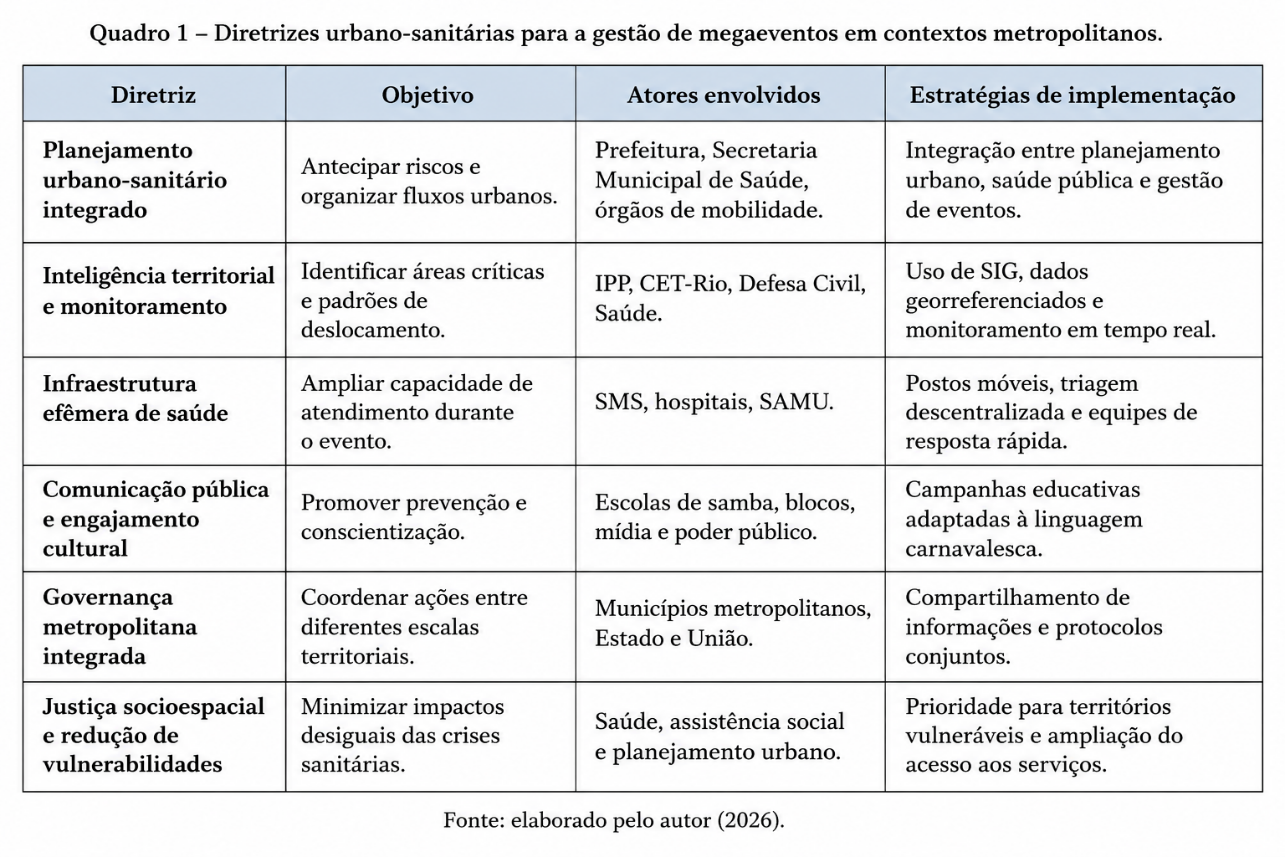
Figure 1 – Urban-health guidelines for the management of mega-events in metropolitan contexts.
Source: prepared by the author (2026).
6 Final Considerations
The analysis developed throughout this article has allowed understanding that pandemics constitute simultaneously biological, social, and spatial phenomena, whose manifestation and impact are deeply conditioned by urban structures. The comparison between the Spanish Flu of 1918–1919 and the COVID-19 pandemic evidenced significant continuities in the relationship among territorial inequality, mobility, social vulnerability, and the spread of diseases, demonstrating that health risks are produced and distributed unequally in urban space.
The investigation of Rio’s Carnival, particularly the emblematic 1919 Carnival, revealed the relevance of cultural manifestations as mechanisms for the symbolic reconstruction of collective life after periods of crisis. More than a popular celebration, Carnival proved to be a complex urban apparatus, capable of strengthening collective bonds and producing forms of symbolic reconstruction of urban life.
The hypothesis that guided this study was confirmed: the spread of diseases does not stem exclusively from population concentration or the holding of large events, but results from the articulation among housing conditions, socio-spatial inequalities, mobility systems, access to urban infrastructure, and institutional governance capacity. In this sense, mega-events function as moments of intensification of dynamics already present in the city, making both their potentialities and their fragilities more visible.
From a theoretical standpoint, the work contributes to the dialogue among urban studies, public health, and cultural analysis by articulating the contributions of Henri Lefebvre, Michel Foucault, and Milton Santos. This convergence allowed understanding Carnival not only as a cultural manifestation, but as an expression of the relationships among the production of space, the management of life, and territorial inequalities, broadening the understanding of the connections among culture, city, and health.
In practical terms, the proposed urban-health guidelines reinforce the need for integrated strategies for the management of mega-events, based on territorial planning, data intelligence, strengthening of health infrastructure, metropolitan governance, and the reduction of socio-spatial vulnerabilities. More than responding to future health crises, such measures contribute to the construction of more resilient, inclusive cities prepared to deal with contexts of high urban complexity.
It is necessary to acknowledge, however, some limitations of the research. The study has a predominantly qualitative and historical-comparative character, based on a literature review, document analysis, and critical interpretation of secondary sources. The absence of empirical surveys, interviews with public managers, organizers, or participants of the contemporary Carnival limits the possibility of deepening certain operational and perceptual dimensions associated with the management of health risks.
As a follow-up, future research may incorporate quantitative analyses, georeferenced data on urban mobility, epidemiological studies applied to mass events, and comparisons with other Brazilian and international cities. Such approaches may contribute to the improvement of governance models capable of integrating culture, urban planning, and public health in metropolitan contexts.
Finally, the article reaffirms that Rio’s Carnival remains one of the most important spaces for the expression of urban life in Rio de Janeiro. Between the memory of the Spanish Flu and the challenges posed by COVID-19, the festivity reveals not only the city’s capacity to celebrate after the crisis, but also the permanent need to construct fairer, more resilient, and more sustainable forms of organizing urban space. This understanding broadens the debate on urban health and mega-events, pointing toward pathways for public policies that recognize culture as a strategic dimension of collective life and of the city’s development.
References
BIBLIOTECA NACIONAL. Carnaval de 1919. Brasiliana Fotográfica, [s.d.]. Available at: https://brasilianafotografica.bn.gov.br/?tag=carnaval-de-1919. Access in: 24 apr. 2025.
BIBLIOTECA NACIONAL. Fotografias sobre o carnaval de 1919. Brasiliana Fotográfica, [s.d.]. Available at: https://brasilianafotografica.bn.gov.br/?p=37725. Access in: 24 apr. 2025.
BORDÉ, Christine. O carnaval, a peste e a “espanhola”. História, Ciências, Saúde – Manguinhos, Rio de Janeiro, v. 7, n. 2, p. 263–280, 2000.
BORDÉ, Christine. A atualidade turística do caso da Gripe Espanhola na cidade do Rio de Janeiro (set. 1918 - mar. 1919). Revista Turismo: Visão e Ação, v. 21, n. 3, p. 547–566, 2019.
BUTTER, David. De sonho e de desgraça: o carnaval carioca de 1919. Rio de Janeiro: Garamond, 2021.
CASTRO, Ruy. Metrópole à beira-mar: o Rio moderno dos anos 20. São Paulo: Companhia das Letras, 2019.
FIGUEREDO, Julia de Arruda. E o mundo não se acabou: o Rio de Janeiro recebe a gripe espanhola e o “maior carnaval de todos os tempos”. 2021. Trabalho de Conclusão de Curso – Universidade Federal do Rio de Janeiro.
FOUCAULT, Michel. Microfísica do poder. Rio de Janeiro: Graal, 1979.
FOUCAULT, Michel. História da sexualidade I: a vontade de saber. Rio de Janeiro: Graal, 1988.
LEFEBVRE, Henri. A produção do espaço. São Paulo: Edusp, 2000.
SANTOS, Ricardo Augusto dos. O carnaval, a peste e a “espanhola”. História, Ciências, Saúde – Manguinhos, Rio de Janeiro, v. 13, n. 1, p. 195–223, 2006.
SANTOS, Milton. A natureza do espaço. São Paulo: Edusp, 2006.
About the Authors
Diego Marques dos Santos Ramos is an Architect and Urban Planner and Set Designer. Professor at the UNILASALLE-RJ University Center (Courses recognized with the MAXIMUM grade, five, by MEC, Architecture and Urbanism and Advertising and Propaganda). PhD in Architecture and Urbanism from PPGAU (Graduate Program in Architecture and Urbanism) – EAU/UFF with a CNPq scholarship, with studies focused on the city as a living stage for socio-cultural manifestations, based on its material and immaterial heritage, symbols, powers, and evoked memories. Master in Urbanism from PROURB (Graduate Program in Urbanism) – FAU/UFRJ with an "Aluno Nota Dez" scholarship from FAPERJ. Graduated in Architecture and Urbanism from the Federal University of Rio de Janeiro and having completed two academic exchange semesters at the Universidad de Chile, in Santiago. Acquiring specialist knowledge in Seisms (Earthquakes), awarded in the CHC 2010 Competition of the International Architecture Biennial in Santiago, Chile, with the project: "ESPACIO T" (Urban Planning of the City in Cases of Catastrophes). Having been Architect – Project Manager at TV Globo/Metroll. Microentrepreneur, Director, and theater actor graduated from SATED – RJ, also works as: set designer, costume designer, producer, and theater teacher at CIA JUKAH DE TEATRO and at Academia DEVANT Espaço de Dança. Set designer for various theatrical productions and private events. Founder and Microentrepreneur of Cia JUKAH de Teatro, awarded for its relevance in the cultural scene of the City of Niterói by the City Council with the Nicette Bruno Diploma.
Lucas Souza Soriano is a student of Architecture and Urbanism | Visual Artist | Theater Actor. Student at UNILASALLE-RJ, with outstanding academic performance as a monitor in the Models and Mockups course. Develops architectural projects at different scales and typologies, including pavilions, residential, school, hospital, and museum buildings, articulating creativity, technique, and aesthetic sensitivity. Currently an intern at the Municipal Secretariat of Urbanism and Mobility of Niterói, participating in processes related to urban planning and the development of the city.
Author Contributions
Conceptualization, [D.M.S.R]; methodology, [D.M.S.R]; formal analysis, [D.M.S.R]; investigation, [D.M.S.R and L.S.S]; data curation, [L.S.S]; writing—original draft preparation, [D.M.S.R and L.S.S]; writing—review and editing, [D.M.S.R]; visualization, [D.M.S.R and L.S.S]; supervision, [D.M.S.R]; project administration, [D.M.S.R and L.S.S]. All authors have read and agreed to the published version of the manuscript.
Acknowledgments
This article is also a tribute to the small gestures of care that sustained life in moments of greatest uncertainty. To my wife, Nicolle Guenther, a physician, whose daily dedication to caring for others has always reminded me that science and sensitivity walk together. To my dear friend Itaiara Lago, for her generous and constant support, which made it possible to get through that period with serenity and hope.
During the pandemic, as classes migrated to screens and the city seemed to reinvent its rhythms, our daughter Athena, then just one year old, discovered the world through the windows of our home. It was necessary to transform a difficult time into a time of imagination, explaining, through play, that there were tiny "little creatures" spread through the air, but that they were no greater than the care, responsibility, trust in science, faith, and, above all, the love we share for one another.
Today I understand that those days taught a lesson that goes beyond this study: cities may fall silent for a time, but hope continues to dwell in encounters, affection, and the human capacity to care. May this work also serve as an acknowledgment to all those who, with courage, studies, and solidarity, helped to transform a period of uncertainties into an opportunity to strengthen the bonds of science and knowledge that keep us truly alive amidst widespread ignorance.
Conflicts of Interest
The author declares no conflict of interest.
About Coleção Estudos Cariocas
Coleção Estudos Cariocas (ISSN 1984-7203) is a publication dedicated to studies and research on the Municipality of Rio de Janeiro, affiliated with the Pereira Passos Institute (IPP) of the Rio de Janeiro City Hall.
Its objective is to disseminate technical and scientific production on topics related to the city of Rio de Janeiro, as well as its metropolitan connections and its role in regional, national, and international contexts. The collection is open to all researchers (whether municipal employees or not) and covers a wide range of fields — provided they partially or fully address the spatial scope of the city of Rio de Janeiro.
Articles must also align with the Institute’s objectives, which are:
- to promote and coordinate public intervention in the city’s urban space;
- to provide and integrate the activities of the city’s geographic, cartographic, monographic, and statistical information systems;
- to support the establishment of basic guidelines for the city’s socioeconomic development.
Special emphasis will be given to the articulation of the articles with the city's economic development proposal. Thus, it is expected that the multidisciplinary articles submitted to the journal will address the urban development needs of Rio de Janeiro.